
Why Do I Understand Spanish in Class but Not in the Street?
Classroom Spanish is designed for learning. Real-life Spanish is designed for living

IN THIS ARTICLE
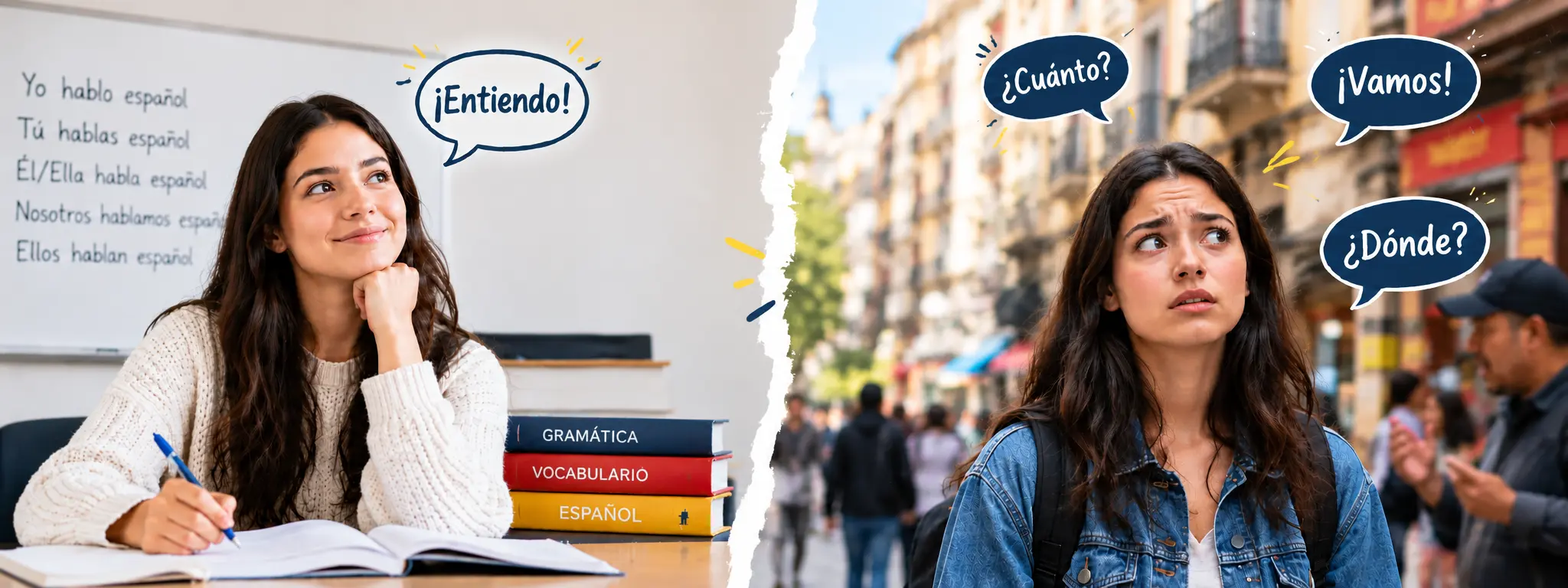
You leave your Spanish class feeling confident. You understood your teacher, followed the exercises, and even managed a short conversation. Then you walk into a café, someone speaks to you, and suddenly you understand nothing.
If this has happened to you, don’t worry. It doesn’t mean your Spanish is bad. It simply means you’re facing one of the most common challenges in language learning: classroom Spanish doesn’t always sound like real-life Spanish.
Classroom Spanish vs. Real-Life Spanish
In class, communication is designed to help you learn. Teachers speak clearly, choose vocabulary for your level, and give you time to process. But in real conversations, Spanish comes at natural speed, with slang, rhythm, and expressions you don’t control.
That’s why ¿Qué hiciste el fin de semana? feels easy, but ¿Y qué hiciste el finde con tus panas? suddenly feels overwhelming. Learning to understand native Spanish speakers requires exposure to the way people communicate outside the classroom.
Your Brain Is Still Translating
Most learners process Spanish through their first language:
sound → word → translation → meaning → response
This takes time, and real conversations don’t wait. You may know the word but not recognize it when spoken quickly. That’s normal. Your brain is still learning to understand spoken Spanish in real time.
Words Don’t Always Sound the Way They Look
Written Spanish is neat. Spoken Spanish is messy.
For example, ¿Para dónde vas? becomes ¿Pa’dónde vas?
Sounds connect, syllables drop, and rhythm changes. Regular Spanish listening practice trains your ear to hear Spanish as it’s actually spoken, not as it appears in a textbook.
The Problem Isn’t Always Vocabulary
Many students think, “I need to learn more words.”
Sometimes that’s true, but not always. You can know most of the words in a conversation and still struggle to understand it.
Why? Because Spanish listening comprehension involves much more than vocabulary. You need to become familiar with:
- Natural speed
- Informal expressions
- Connected speech
- Intonation and rhythm
- Context clues
How to Improve Your Listening
If you want to improve your Spanish listening, try this three-step approach:
- Listen for the general idea. Don’t worry about every word. Just ask yourself what the conversation is about.
- Pick out familiar words. On a second listen, focus on expressions you already know.
- Use context. Look at who is speaking, where they are, and what’s happening. Often, that’s enough to guess the meaning. A translation app can still pick the wrong sense of a familiar word, as in these Google Translate mix-ups in Spanish.
This kind of Spanish conversation practice helps you become more comfortable with the pace and rhythm of everyday speech.
You don’t need to understand every word. You only need to understand enough to keep the conversation going.
Don’t Be Afraid to Ask
“Could you speak a little more slowly?” or “Could you repeat that?” are not failures. They’re part of a natural Spanish conversation.
The goal isn’t perfection. It’s connection.
When Spanish Starts to Feel Natural
With enough exposure, you’ll stop translating. You’ll simply understand.
Whether you practice in person or learn Spanish online, consistent exposure helps your brain recognize familiar words and expressions more quickly.
That’s when Spanish becomes more than something you study. It becomes something you use.
Take Your Spanish Beyond the Classroom
At Spondylus Languages, we believe online Spanish classes should prepare you for real communication, not just textbook exercises.
Because Spanish shouldn’t stop working when class ends. It should start working when you walk out the door.
Ready to practice real Spanish?
Choose a lesson package built for conversation, or take the assessment to find a useful starting point.