When Google Translates... and Everyone Ends Up Laughing
Two real student mix-ups show why a Spanish word means what the situation says it means, not what an app lists first

IN THIS ARTICLE
Learning a language also means experiencing fun and unexpected moments. Some of our students’ best stories come from small misunderstandings that eventually become great memories and valuable learning experiences.
At Spondylus Languages, we encourage students to use Spanish in real-life situations. That is also the heart of our mission to teach through real communication. The laughs that follow are part of how students describe what sticks.
A Drink Order That Turned Cola into “Tail”
On one occasion, a couple visiting Ecuador took part in one of our city immersion activities. As part of the challenge, we asked them to order their meal in Spanish at a local restaurant.
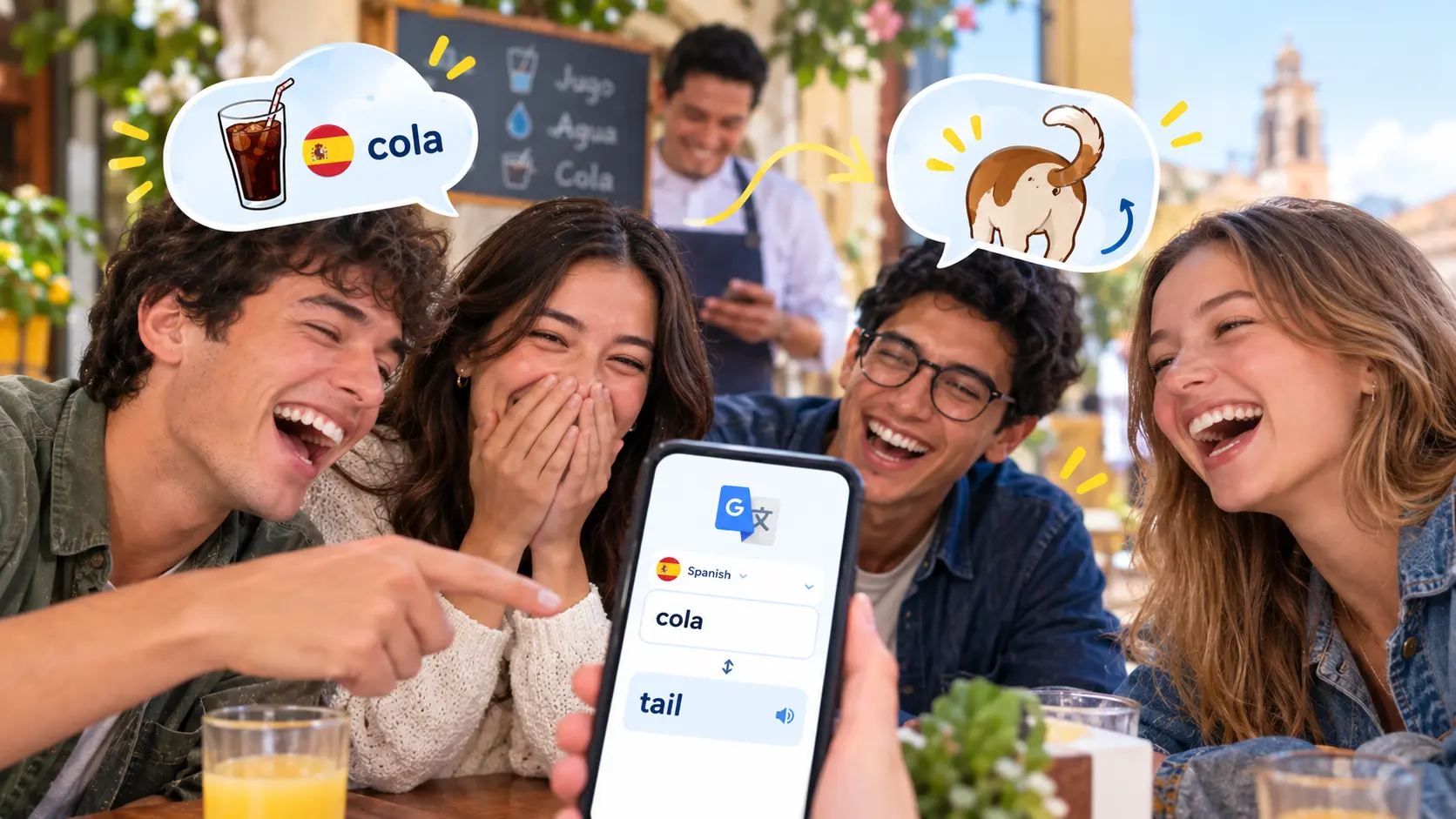
Everything was going very well until it was time to order drinks. The waiter asked if they would like jugo (juice), agua (water), or cola. We had already covered drink vocabulary in live Spanish class, so everything seemed ready. However, we had forgotten one very important word that is commonly used throughout Latin America, and unfortunately, it happened to be one of the options on the menu.
Unsure of what it meant, they quickly turned to Google Translate. To their surprise, the translation they found for cola was “tail.”
For a moment, they were completely confused. Why was the waiter offering them a tail? In English, tail refers to the rear part of an animal, while in Spanish, cola can also refer to a soft drink, such as cola or soda. Once they understood the meaning, both the students and the waiter couldn’t stop laughing. The misunderstanding became one of their favorite stories from the trip and a word they will probably never forget.
Same word, two situations
La cola del gato.
The cat’s tail.
¿Quiere jugo, agua o cola?
Would you like juice, water, or a soft drink?
Laughing at the mix-up did not slow them down. In conversation-first Spanish lessons, that kind of moment is often when students stop worrying about a perfect sentence and start enjoying the exchange. Travelers who want more of those restaurant conversations can look at immersive Spanish experiences in Ecuador.
The Chocolate Cake That Called for Petroleum
In another activity, this time during a cooking class for children, one student decided to bake a chocolate cake. As we were reviewing the recipe and ingredients, she confidently told us that one of the ingredients she needed was “petroleum.”
When we heard her say it, we assumed we had misunderstood. We asked her to repeat the word, and to our surprise, she said it again: “petroleum.” We all looked at each other for a moment because petroleum is obviously not an ingredient you would use to make a cake.
Later, we discovered what had happened. The student had searched for the English word oil, and one of the translations she found was petróleo (petroleum). While the translation can be correct in certain contexts, it was not the right word for a cooking recipe. What she actually needed was aceite, or more specifically, cooking oil. Once we cleared up the misunderstanding, everyone burst out laughing, including the student herself.
Oil is not one Spanish word
Aceite de cocina.
Cooking oil. This is the word for a recipe.
Petróleo.
Petroleum. A possible translation of “oil,” and the
wrong one in a kitchen.
Children often recover from a mistake like this faster than adults do. They listen, repeat, and keep speaking without treating one wrong word as a reason to stop. The conversational Spanish class books are built the same way: useful words inside real situations, not a list to memorize on its own.
Why a Translation App Misses the Meaning
Stories like these help our students learn one of the most important lessons of language learning: automatic translations do not always provide the right word. The meaning of a word depends on its context, and in Spanish, as in any language, the same word can have different meanings and uses.
Google Translate had a real Spanish meaning both times. Cola can be a tail. Petróleo can be oil. The app could not see the menu, the waiter, or the cake recipe. That is the same gap learners feel when classroom Spanish falls apart in the street. In class, the situation is prepared. Outside, you have to read the room.
If your brain still runs every Spanish word through English first, a translation app makes that habit stronger. The piece on why your brain is still translating explains the delay. Context is the shortcut: who is speaking, where you are, and what is happening often tells you which meaning is possible.
That is why learning Spanish is about much more than memorizing vocabulary lists. It is about understanding how people use words in real-life situations, making mistakes, laughing about them, and turning every experience into an opportunity to learn. And honestly, it is often these small moments of confusion that our students remember for years to come.
A translation app can offer a possible meaning. The situation decides which meaning is the useful one.
Ready to use Spanish where the meaning is obvious?
A live lesson or an immersion experience gives you a real situation, a person to ask, and a better word than the first one an app suggests.